
Quick Verdict
Dermacept is marketed as an oral beauty supplement designed to support healthier-looking skin from within. The official website highlights ingredients and research relating to skin health, including curcumin, Boswellia, ginkgo biloba, B vitamins, magnesium, licorice root, cinnamon extract, and chromium picolinate.
My main concern is formula transparency. The accessible official website does not provide a complete Supplement Facts panel with the amount of each ingredient, making it difficult to determine whether the product provides clinically meaningful doses. I also did not find a published randomized controlled trial testing Dermacept itself for skin rejuvenation, collagen production, or anti-aging.
Some individual ingredients have human research behind them, particularly curcumin and certain skin-related botanical compounds. However, evidence for individual ingredients does not establish that the finished Dermacept formula produces the same results.
| Factor | Editorial Assessment |
|---|---|
| Product type | Oral dietary supplement |
| Primary purpose | Skin and beauty support |
| Format | Capsules |
| Listed ingredients | Curcumin, Boswellia, Ginkgo biloba, B vitamins, magnesium, licorice root, cinnamon extract, chromium picolinate |
| Dosage transparency | Limited on the accessible website |
| Whole-product clinical trial | Not identified |
| Money-back guarantee | 60 days, according to the official website |
| Overall assessment | Interesting ingredients, but insufficient product-level evidence and limited label transparency |
What Is Dermacept?
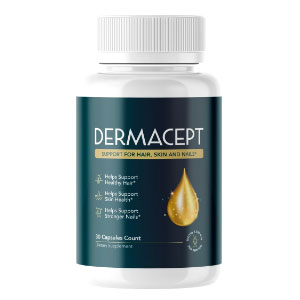 Dermacept is a dietary supplement positioned around the idea of supporting skin health from within. Rather than functioning like a topical cream or serum, it is marketed as an oral formula containing botanical extracts, vitamins, and minerals.
The official website presents scientific references involving skin-related mechanisms such as inflammation, oxidative stress, microcirculation, pigmentation, skin barrier function, and collagen-related processes.
That distinction matters because a scientific reference about an ingredient does not automatically demonstrate that the finished supplement produces a visible anti-aging effect.
Dermacept Ingredients
The accessible Dermacept website lists eight main ingredient groups:
- Curcumin/Turmeric: A compound extensively studied for antioxidant and anti-inflammatory activity.
- Boswellia extract: A botanical traditionally investigated for inflammatory pathways.
- Ginkgo biloba: Studied for vascular and microcirculatory effects.
- B-complex vitamins: Essential nutrients involved in numerous cellular processes.
- Magnesium: An essential mineral involved in hundreds of biochemical reactions.
- Licorice root: Contains compounds that have been investigated for pigmentation and inflammatory skin conditions.
- Cinnamon extract: Provides polyphenolic compounds with antioxidant activity and has been investigated for several metabolic effects.
- Chromium picolinate: A supplemental form of chromium primarily studied in relation to glucose and insulin metabolism.
The important limitation is that the accessible official page does not clearly show the exact amount of each ingredient per serving. That makes it difficult to compare the formulation with doses used in clinical research.
What Does the Research Say?
Curcumin has the strongest skin-related evidence among the listed ingredients.
A systematic review published in the Journal of Clinical and Aesthetic Dermatology examined clinical research involving turmeric and curcumin for skin health. The review identified 18 human studies, including oral and topical applications, but concluded that the evidence remained limited and that additional research was necessary.
View the PubMed study on turmeric and skin health
A newer systematic review published in 2023 identified 18 randomized controlled trials involving curcumin for various dermatologic conditions. Some conditions showed promising results, but the evidence varied considerably by condition and application.
View the PubMed systematic review of curcumin for dermatologic conditions
This is encouraging for curcumin as an ingredient, but it does not prove that Dermacept itself reduces wrinkles, increases collagen, or produces a younger-looking complexion.
Ginkgo biloba has some human research involving skin circulation.
A randomized placebo-controlled crossover study involving 27 healthy middle-aged participants examined Ginkgo biloba extract and skin blood flow. The researchers found that the extract influenced skin blood flow, although the response varied between participants.
View the PubMed study on Ginkgo biloba and skin blood flow
Another clinical study found increased blood flow in the nail-fold capillaries after Ginkgo biloba administration. However, these findings relate to circulation rather than demonstrating an anti-aging effect.
View the PubMed study on Ginkgo biloba and microcirculation
Licorice has some evidence for pigmentation-related applications.
One clinical trial examined a topical combination containing licorice, emblica, and belides for melasma. The study reported improvements in pigmentation, but the formulation was topical and contained multiple ingredients. It therefore cannot be used as direct evidence that oral Dermacept reduces hyperpigmentation.
View the PubMed study on licorice and melasma
Potential Dermacept Benefits
Based on the formula and available ingredient research, Dermacept may be reasonably described as a product intended to support:
- General skin wellness
- Antioxidant protection
- Normal inflammatory balance
- Overall nutritional support for skin
- Healthy-looking complexion
- Normal skin function
I would be more cautious with stronger claims such as “reverses wrinkles,” “restores collagen,” “removes age spots,” or “works like Botox.” The available evidence does not establish those outcomes for the finished product.
Does Dermacept Really Work?
The answer depends on what “work” means.
If the question is whether some Dermacept ingredients have biological activity relevant to skin health, the answer is yes. Curcumin, for example, has been investigated in multiple human studies involving dermatological conditions.
If the question is whether Dermacept has been clinically proven to make skin look younger, smoother, or more youthful, the evidence is much weaker.
I could not identify a peer-reviewed randomized clinical trial testing the complete Dermacept formula for those outcomes.
That distinction is important when evaluating supplement marketing.
Dermacept Pros and Cons
Pros
- Contains several ingredients with established biological and nutritional research.
- Curcumin has been studied in human dermatology research.
- The formula combines botanical ingredients with vitamins and minerals.
- The company provides scientific references on its website.
- The official website states that purchases are covered by a 60-day money-back guarantee.
Cons
- The accessible website does not clearly disclose individual ingredient dosages.
- No clinical trial of the complete Dermacept formula was identified.
- Ingredient research cannot be treated as proof of finished-product effectiveness.
- Some marketing claims appear stronger than the available product-level evidence.
- Independent customer feedback should be interpreted cautiously because the official site reports testimonials and reviews supplied by users. :chatgpt-content-reference{index=”4″}
Dermacept Customer Reviews
The official Dermacept website currently displays a 4.98/5 rating based on 2,000+ reviews. However, the page does not provide enough information for me to independently verify the underlying review platform or methodology.
I would therefore treat this rating as a brand-reported figure, rather than independent evidence of product effectiveness.
There are also third-party reports containing both positive and negative experiences associated with Dermacept-branded websites. However, different websites and formulations appear online, so it is important not to automatically assume that every Dermacept listing represents the same product or seller.
Is Dermacept Safe?
Safety depends heavily on the actual doses and the individual’s health status.
The absence of clearly accessible ingredient quantities makes a complete safety assessment more difficult.
Ginkgo biloba can affect bleeding risk and may interact with medications, particularly anticoagulant or antiplatelet drugs. Curcumin and other botanicals can also interact with medications depending on dose and formulation.
Anyone taking prescription medication, preparing for surgery, pregnant or breastfeeding, or managing a chronic medical condition should discuss the product with a healthcare professional before using it.
The official website itself advises consumers to discuss health changes with a qualified medical professional and states that its information is not a substitute for medical advice. Dermacept
Dermacept Pricing and Guarantee
The accessible official website states that Dermacept comes with a 60-day money-back guarantee. It says customers can request a refund within 60 days and that even an empty bottle can be returned. en-us-dermacept.com
Because online Dermacept pages show differing package prices and product information, I recommend checking the final checkout price, package size, shipping costs, refund terms, and exact Supplement Facts panel before purchasing.
Who Should Consider Dermacept?
Dermacept may be of interest to adults who want an oral nutritional supplement as an addition to an established skincare and healthy-lifestyle routine.
However, I would not treat it as a replacement for proven skin-health measures such as sun protection, adequate nutrition, appropriate topical skincare, sleep, and medical evaluation of persistent or concerning skin changes.
Who Should Avoid or Discuss Dermacept With a Doctor First?
Medical advice is particularly important for people who:
- Take blood-thinning or antiplatelet medication.
- Take multiple prescription medications.
- Have a chronic medical condition.
- Are pregnant or breastfeeding.
- Have a planned surgery or procedure.
- Have allergies to any botanical ingredients.
Dermacept vs. Other Skin Supplements
| Factor | Dermacept | What I Look For in a Skin Supplement |
|---|---|---|
| Ingredient variety | Broad botanical + nutrient formula | Depends on the intended goal |
| Dosage transparency | Limited on accessible website | Clearly stated amounts per serving |
| Whole-product evidence | Not identified | Prefer human trials on the finished formula |
| Ingredient research | Several ingredients have published research | Research should match the claimed benefit |
| Safety assessment | More difficult without exact doses | Complete Supplement Facts panel |
Final Verdict
Dermacept has an interesting ingredient concept, particularly because curcumin and several of its botanical components have been studied for biological effects relevant to skin health. Human research provides some support for turmeric/curcumin in specific dermatological applications, but systematic reviews also emphasize the limitations of the existing evidence.
My biggest reservation is not the presence of the ingredients; it is the lack of readily accessible dosage information and the absence of convincing clinical evidence on the finished Dermacept formula.
For that reason, I would consider Dermacept a potentially interesting beauty supplement rather than a clinically proven anti-aging treatment. The ingredient science gives the formula some rationale, but the product-level evidence is not strong enough to support aggressive claims about wrinkle reduction, collagen restoration, or dramatic skin rejuvenation.
Before purchasing, I would verify the current Supplement Facts panel, exact ingredient doses, manufacturer information, return conditions, and final checkout price.