
Introduction
Tracking body weight alone does not always provide a complete picture of physical progress. Someone following a fitness or weight-management program may lose body fat while maintaining muscle, or experience changes in water weight without meaningful changes in body composition.
The Hume Body Pod 2.0 from Hume Health aims to provide more detailed information through at-home body composition analysis. Unlike conventional bathroom scales, this connected analyzer estimates multiple measurements, including body fat percentage, muscle mass, visceral fat, body water, and metabolic age.
The device uses multi-frequency bioelectrical impedance analysis (BIA) and hand-and-foot sensors to estimate different body composition measurements. Its accompanying smartphone application organizes these results into reports and longer-term progress trends.
This approach may appeal to adults interested in weight management, strength training, muscle preservation, and general wellness.
But how accurate are its measurements? Can it help distinguish fat loss from muscle loss? And is it worth the investment compared with other smart body composition scales?
In this Hume Body Pod 2.0 review, I examine its technology, features, potential benefits, scientific research, customer feedback, pricing, and limitations to help readers make an informed purchasing decision.
Quick Summary Box
| Feature | Details |
|---|---|
| Product Name | Hume Body Pod 2.0 |
| Manufacturer | Hume Health |
| Product Category | Smart body composition analyzer |
| Primary Purpose | Body fat, muscle, and health tracking |
| Technology | Bioelectrical Impedance Analysis (BIA) |
| Sensor System | Hand-and-foot contact sensors |
| Measurements | 45 advertised metrics |
| Body Composition | Fat mass, muscle mass, body water, and visceral fat estimates |
| Additional Features | Metabolic age, BMR, heart rate, and segmental analysis |
| Display | 2.8-inch display |
| Weight Capacity | Up to 441 lbs (200 kg) |
| Connectivity | Bluetooth |
| App | Hume Health App |
| Subscription | Optional Hume Plus membership |
| Warranty | 1 year standard; optional extended coverage |
| Return Policy | Advertised 45-day return policy, subject to conditions |
Note: Product specifications and commercial terms are based on manufacturer information. Measurement accuracy and clinical usefulness depend on the specific metric and testing conditions.
What Is Hume Body Pod 2.0?
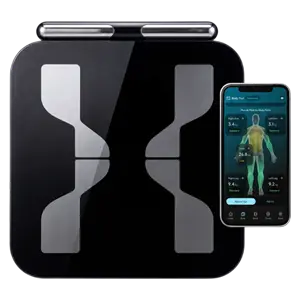 Hume Body Pod 2.0 is a connected smart scale designed to estimate body composition rather than simply measure body weight.
Developed by Hume Health, the device combines a weighing platform with handheld sensors. This arrangement allows it to collect electrical impedance information through the hands and feet, helping its algorithms estimate different body regions.
The manufacturer advertises 45 body composition and wellness-related metrics.
These include:
- Body weight and BMI.
- Body fat percentage and fat mass.
- Muscle mass and skeletal muscle mass.
- Visceral fat estimates.
- Metabolic age.
- Basal metabolic rate (BMR).
- Total body water.
- Intracellular and extracellular water estimates.
- Segmental arm, leg, and trunk measurements.
- Body composition symmetry insights.
- Heart rate measurement.
One distinguishing feature is its segmental measurement system. Instead of relying only on foot-to-foot measurements, the handheld system collects additional information through the upper body.
The Hume Health application stores measurements and presents historical trends, allowing users to compare changes over weeks and months.
Importantly, these measurements are algorithm-based estimates, not direct measurements of every tissue or organ.
How Does Hume Body Pod 2.0 Work?
Hume Body Pod 2.0 uses bioelectrical impedance analysis (BIA), a technology commonly used in consumer and professional body composition equipment.
The technology works by passing a very low-level electrical current through the body and measuring resistance and reactance.
Different tissues conduct electricity differently. Water-rich tissues generally conduct electrical current more easily than fat tissue.
The device uses these electrical measurements, together with user information and its internal algorithms, to estimate body composition.
1. Multi-Frequency BIA Technology
Hume advertises an eight-frequency BIA system designed to collect information about body composition and water distribution.
Using multiple frequencies may provide additional information about different body compartments compared with basic single-frequency devices.
2. Hand-and-Foot Sensor System
The device combines platform electrodes with handheld contacts. According to Hume, this arrangement supports segmental estimates for the arms, legs, and torso.
This may provide more detailed information than conventional scales that primarily measure electrical impedance through the lower body.
3. Body Composition Analysis
The system processes collected impedance information to estimate measurements such as body fat, muscle mass, water distribution, and visceral fat.
4. Smartphone Application and Progress Reports
After measurement, results synchronize with the Hume Health application.
Users can review individual readings, compare historical results, and observe weekly, monthly, and yearly trends.
For more consistent measurements, Hume recommends weighing in the morning under similar conditions.
Hume Body Pod 2.0 Key Ingredients and Technology
Hume Body Pod 2.0 does not contain conventional ingredients such as vitamins, minerals, or herbal extracts. Its functionality depends on electrical impedance technology, sensors, and software algorithms.
The following components explain the technology behind its measurements.
1. Bioelectrical Impedance Analysis (BIA)
BIA is the primary technology used to estimate body composition.
It measures how electrical current travels through body tissues. The resulting impedance information helps estimate fat mass, fat-free mass, and body water.
Potential role: Helps users distinguish changes in estimated body fat, muscle, and water rather than relying exclusively on body weight.
Scientific evidence: A 2024 systematic review and meta-analysis published in Clinical Nutrition evaluated the validity of BIA against a four-compartment body composition model.
The findings highlighted differences between BIA devices and reference methods, emphasizing that results can vary depending on the equipment and individual.
2. Multi-Frequency Electrical Measurements
Multi-frequency BIA systems use different electrical frequencies to gather information about body water and other composition-related measurements.
Potential role: Provides additional information for estimating total body water and regional body composition.
Scientific evidence: A 2024 study published in Frontiers in Nutrition examined the reliability and accuracy of multi-frequency BIA compared with DXA.
The researchers reported high test-retest reliability under controlled conditions. However, they also identified differences between BIA and DXA measurements of body fat and fat-free mass.
3. Segmental Body Composition Sensors
Hume Body Pod 2.0 uses hand-and-foot contact points to estimate composition across different body regions.
Potential role: Provides estimated measurements for the arms, legs, and trunk, helping users observe regional changes during training or weight management.
Segmental measurements may offer more information than a conventional bathroom scale, although the estimates still depend on the device’s algorithms.
4. Body Water Measurement
The device estimates total body water, intracellular water, and extracellular water.
Potential role: Helps users observe hydration-related changes that may influence body weight and body composition readings.
Scientific evidence: The previously mentioned multi-frequency BIA research examined the reliability of whole-body and regional water measurements.
However, these estimates should not replace medical assessments of hydration or fluid balance.
5. Body Fat and Muscle Mass Estimation
Hume Pod 2.0 estimates fat mass, skeletal muscle mass, and other lean-tissue measurements.
Potential role: Helps users follow changes in estimated fat and muscle during exercise, nutrition, and weight-management programs.
Scientific evidence: A 2023 systematic review and meta-analysis compared BIA with DXA for assessing body composition in athletes.
The researchers found that correlations could be high while individual measurement differences remained substantial.
Editorial assessment: Scientific research supports BIA as a practical body composition estimation method. However, general BIA research does not automatically validate every Hume Pod 2.0 measurement. Independent device-specific validation remains important, particularly for visceral fat, metabolic age, bone-related estimates, and individual segmental readings.
Hume Body Pod 2.0 Benefits
Hume Body Pod 2.0 offers several potential advantages for people who want more detailed information about their physical progress.
- Track Body Fat: Monitor estimated body fat percentage and fat mass rather than relying exclusively on weight changes.
- Monitor Muscle Growth: Follow estimated muscle mass during resistance training and fitness programs.
- Evaluate Visceral Fat: Observe estimated changes in fat stored around internal organs.
- Analyze Body Symmetry: Compare estimated muscle and fat distribution between different body regions.
- Measure Hydration Trends: Review estimated body water and related measurements.
- Assess Metabolic Indicators: Explore BMR and app-generated metabolic age estimates.
- Compare Long-Term Progress: Review historical measurements and identify changes over several months.
- Improve Fitness Awareness: Use body composition information to support more informed training and nutrition decisions.
These features can make progress tracking more informative. However, the device does not directly cause fat loss, build muscle, or improve metabolic health.
Hume Body Pod 2.0 Pros and Cons
| Pros | Cons |
|---|---|
| Multiple body composition estimates | Measurements are algorithm-based estimates |
| Hand-and-foot sensor arrangement | Requires correct positioning and consistent conditions |
| Segmental body composition insights | Individual regional accuracy needs further validation |
| Historical progress tracking | Daily hydration changes can influence results |
| Smartphone application integration | Requires smartphone and Bluetooth connectivity |
| Multiple user accounts | Only one phone connects at a time |
| Optional Premium membership | Advanced coaching requires additional payment |
| Advertised 45-day return policy | Return conditions and product eligibility apply |
Comparison Table: Hume Body Pod 2.0 Alternatives
Several smart scales and body composition analyzers offer similar functionality. Comparing their measurement technology, features, and pricing can help determine which device offers the best value.
| Feature | Hume Body Pod 2.0 | Withings Body Smart | InBody H20N | RENPHO Smart Scale |
|---|---|---|---|---|
| Product Type | Smart body analyzer | Smart scale | Body composition analyzer | Smart scale |
| BIA Technology | Multi-frequency advertised | BIA | Multi-frequency BIA | Model-dependent BIA |
| Hand Sensors | Yes | No | Yes | Usually no |
| Body Fat Estimate | Yes | Yes | Yes | Yes |
| Muscle Measurement | Yes | Yes | Yes | Model-dependent |
| Segmental Analysis | Yes | Limited | Yes | Model-dependent |
| App Integration | Hume Health | Withings | InBody | RENPHO Health |
| Price Position | Mid-range | Mid-range | Premium | Budget to mid-range |
Comparison takeaway: Hume Body Pod 2.0 is worth considering for users interested in segmental body composition estimates and connected progress tracking. InBody H20N is another option for people who prefer hand-and-foot BIA technology, while Withings and RENPHO offer alternatives at different price points.
Hume Body Pod 2.0 Customer Reviews
Customer feedback provides additional information about everyday usability, setup, app functionality, and measurement consistency.
Hume Health displays customer testimonials and a 4.8/5 rating with more than 48,000 reviews on its product page. These are manufacturer-displayed figures and should not be interpreted as independently audited ratings for the Body Pod 2.0 alone.
The company’s customer feedback highlights several recurring themes:
- Interest in detailed body composition measurements.
- App-based progress tracking and historical reports.
- Convenience of combining weight and body composition measurements.
- Interest in monitoring muscle and fat changes during fitness programs.
- Questions about measurement consistency and interpretation.
An important consideration is that customer satisfaction does not establish measurement accuracy. A device may be easy to use and provide useful progress charts without matching laboratory measurements for every individual.
Editorial assessment: The product offers an extensive set of tracking features, but prospective buyers should distinguish manufacturer-selected testimonials from independent product testing. I would give greater weight to repeatability, transparent validation studies, and return conditions when evaluating its overall value.
Who Should Use Hume Body Pod 2.0?
Hume Body Pod 2.0 may be suitable for adults who want more information about body composition than a conventional weighing scale provides.
Potential users include:
- People following structured weight-management programs.
- Fitness enthusiasts monitoring muscle development.
- Adults interested in tracking body fat trends.
- People following resistance-training programs.
- Individuals interested in monitoring estimated hydration changes.
- Users who prefer detailed smartphone-based progress reports.
- Households that want individual measurement profiles.
Who Should Avoid It?
The device may not be appropriate for everyone.
- People who need medically accurate body composition assessments.
- Individuals who require diagnostic testing for visceral fat or metabolic conditions.
- People who may become overly concerned with frequent body measurements.
- Users who do not want to depend on a smartphone application.
- Individuals with implanted electronic medical devices who have not confirmed BIA safety with their healthcare professional and device manufacturer.
- Anyone expecting the scale to independently produce weight loss or muscle growth.
Hume Body Pod 2.0 Side Effects and Safety
Hume Body Pod 2.0 uses low-level electrical current for bioelectrical impedance measurements. It is a non-invasive device and does not administer medication or supplements.
However, several safety considerations deserve attention.
1. Implanted Medical Devices
People with pacemakers, implantable cardioverter-defibrillators, or other electronic medical devices should consult their healthcare professional and the implant manufacturer before using BIA equipment.
Do not rely solely on general manufacturer assurances when individual device compatibility matters.
2. Hydration and Measurement Variations
Fluid intake, meals, exercise, alcohol consumption, and measurement timing can influence BIA results.
For consistent comparisons, measure under similar conditions and avoid interpreting every daily change as actual fat or muscle gain.
3. Pregnancy
Pregnancy changes body water distribution and body composition. Standard consumer BIA estimates may not be appropriate for monitoring pregnancy-related changes. Consult a healthcare professional.
4. Medical Conditions
People with kidney disease, heart conditions, edema, or other conditions affecting fluid balance should not use consumer BIA readings to make medical decisions.
5. Body Image and Frequent Tracking
Frequent measurements may create unnecessary concern about normal fluctuations. Focus on meaningful long-term trends rather than reacting to individual readings.
6. Diagnostic Limitations
Hume Body Pod 2.0 is a consumer body composition analyzer. Its estimated bone, visceral fat, metabolic age, and other metrics should not replace clinical investigations or medical assessments.
Hume Body Pod 2.0 Pricing and Packages
According to the official Hume Health product listing, Hume Body Pod 2.0 is advertised at a promotional price of approximately $249, compared with a displayed regular price of $384.
The device is offered in different color options, including black and white.
The standard purchase includes:
- One Hume Body Pod 2.0 analyzer.
- Integrated hand-and-foot measurement system.
- Digital display.
- Rechargeable battery.
- Bluetooth connectivity.
- Access to the Hume Health application.
- One-year standard warranty.
| Purchase Option | Advertised Price |
|---|---|
| Hume Body Pod 2.0 | $249 promotional price |
| Regular Displayed Price | $384 |
| Hume Plus Membership | $9.99/month |
| Optional 10-Year Warranty | Approximately $46 promotional price |
The basic application allows users to weigh in and view body composition information without requiring a Premium subscription. Hume Plus adds coaching and more detailed reports.
The manufacturer also advertises a 45-day return policy. Returned devices must meet the stated condition and original packaging requirements, and purchases must be made directly from Hume to qualify under the published terms.
Pricing note: Promotional prices, warranty options, shipping, and return conditions may change. Confirm the final checkout price and applicable terms before purchasing.
Frequently Asked Questions
1. What is Hume Body Pod 2.0 used for?
Hume Body Pod 2.0 is a smart body composition analyzer designed to estimate body fat, muscle mass, visceral fat, body water, metabolic age, and other health-related measurements. It also tracks weight and historical progress through its connected application.
2. How accurate is Hume Body Pod 2.0?
The device uses bioelectrical impedance analysis to estimate body composition. Hume advertises accuracy within approximately 2% of DEXA for body fat percentage. However, that is a manufacturer-reported claim, and individual accuracy can vary with hydration, measurement conditions, and personal characteristics. It should not be treated as a substitute for clinical assessment.
3. Does Hume Body Pod 2.0 measure visceral fat?
Yes. It provides an estimated visceral fat measurement. This metric can help users observe trends, but it does not directly measure abdominal organ fat or diagnose metabolic disease.
4. Can Hume Body Pod 2.0 track muscle growth?
Yes. The analyzer estimates muscle mass and provides segmental measurements for different body regions. Users can compare these estimates over time to monitor potential changes during exercise and resistance training.
5. Does Hume Body Pod 2.0 require a subscription?
No. The basic Hume Health application provides access to weigh-ins and body composition information without a mandatory subscription. Hume Plus is optional and adds coaching and more detailed reports.
6. Can multiple people use Hume Body Pod 2.0?
Yes. The manufacturer states that multiple users can connect individual Hume accounts to the device. However, Bluetooth connectivity is limited to one connected phone at a time.
7. Does Hume Body Pod 2.0 measure metabolic age?
Yes. It provides an estimated metabolic age based on its body composition analysis and algorithms. This is a proprietary wellness metric, not a clinically established measurement of biological age or lifespan.
8. Is Hume Body Pod 2.0 suitable for weight loss programs?
It may be useful for people following weight-management programs because it provides estimated fat mass, muscle mass, and body water measurements. These metrics can offer additional context beyond weight alone, but the device does not cause weight loss.
9. Is Hume Body Pod 2.0 safe to use every day?
The device uses low-level electrical current for BIA measurements. Many people can use consumer BIA devices without difficulty, but individuals with implanted electronic medical devices or medical conditions affecting fluid balance should seek professional guidance before use.
10. Where can I buy Hume Body Pod 2.0?
Hume Body Pod 2.0 is available through the manufacturer’s official website. Purchasing directly from Hume allows buyers to review the current promotional price, warranty, shipping information, and return conditions.
Final Verdict: Is Hume Body Pod 2.0 Worth Buying?
Hume Body Pod 2.0 offers a more detailed approach to at-home body composition tracking than a conventional bathroom scale. Its multi-frequency BIA technology, handheld sensors, segmental analysis, and connected application provide several measurements that may help users understand changes in estimated body fat, muscle mass, and body water.
Its biggest advantage is the ability to monitor more than body weight. This can be particularly useful for people following resistance-training or weight-management programs who want to observe whether their progress involves changes in estimated fat and muscle mass.
However, measurement accuracy deserves careful consideration. BIA technology has scientific support, but its results can differ from DXA and other reference methods. Hume’s advertised accuracy claims should also be distinguished from independently published, peer-reviewed validation of the specific device and its individual metrics.
My assessment: Hume Body Pod 2.0 is worth considering for adults who want detailed at-home body composition estimates and convenient progress tracking. Its strongest value lies in monitoring trends rather than treating individual readings as definitive measurements.
It may be less suitable for people who require clinical body composition assessments, medical diagnosis, or laboratory-level accuracy.
Overall, Hume Body Pod 2.0 offers an interesting combination of connected technology and body composition tracking. Buyers who understand the limitations of BIA and want a more comprehensive alternative to traditional weighing scales may find it a useful addition to their fitness routine.
Scientific References and Further Reading
- The Validity of Bioelectrical Impedance Analysis Compared to a Four-Compartment Model in Healthy Adults: A Systematic Review.
- Reliability, Biological Variability, and Accuracy of Multi-Frequency Bioelectrical Impedance Analysis for Measuring Body Composition Components.
- Agreement Between Dual-Energy X-Ray Absorptiometry and Bioelectrical Impedance Analysis for Assessing Body Composition in Athletes: A Systematic Review and Meta-Analysis.
- Bioelectrical Impedance Analysis – Scientific and Clinical Background.