
Introduction
Phenetrine is a once-daily dietary supplement from Vitasource Health marketed for weight management, appetite control, stress-related cravings, glucose metabolism, and fat metabolism.
The current formula contains seven listed ingredients: phosphatidylserine, Ginkgo biloba, N-acetyl L-carnitine HCl, St. John’s wort, L-glutamine, Bacopa monnieri extract, and alpha-GPC. The manufacturer describes the formula as a “triple-action” approach involving cortisol, appetite, and metabolism.
The formulation has some scientifically interesting ingredients, but the evidence needs careful interpretation. Most importantly, there is no published randomized controlled trial demonstrating that Phenetrine itself produces the weight-loss results claimed on its website.
Quick Summary
| Product | Phenetrine |
|---|---|
| Brand | Vitasource Health |
| Category | Weight-management dietary supplement |
| Format | Capsules |
| Serving | 1 capsule daily |
| Main Focus | Weight management, appetite, stress and metabolic support |
| Total Formula | 750 mg listed active ingredients |
| Product-Specific RCT | None located |
| Prescription Required | No |
| Current Price | From $59 per bottle |
| Guarantee | 60-day money-back guarantee |
The current Vitasource product page lists one capsule daily, preferably before the first meal, and describes a 30-day supply at the single-bottle price.
What Is Phenetrine?
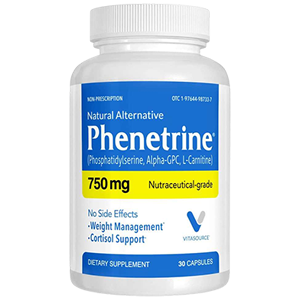 Phenetrine is a non-prescription dietary supplement designed around the idea that stress, appetite, and metabolic processes can influence weight management.
The manufacturer specifically promotes three mechanisms: cortisol support, appetite control, and metabolic regulation. It also claims that Phenetrine can activate AMPK pathways and support healthy glucose metabolism. These are manufacturer claims and should not be confused with clinical evidence that the finished product causes weight loss.
The product contains no conventional stimulant such as caffeine according to the current Supplement Facts panel, but it does contain several botanicals with pharmacological activity, particularly St. John’s wort and Ginkgo biloba.
How Does Phenetrine Work?
Phenetrine’s proposed mechanism is different from stimulant-based fat burners.
Phosphatidylserine is included for stress-response and cortisol-related support. L-carnitine is associated with fatty-acid transport and energy metabolism. Bacopa and Ginkgo are primarily known for cognitive effects, while St. John’s wort has effects on several drug-metabolizing pathways and neurotransmitter systems.
The problem is that these mechanisms do not demonstrate clinically meaningful weight loss from the complete formula. Several ingredients have been studied for other outcomes rather than obesity.
Phenetrine Ingredients
1. Phosphatidylserine — 125 mg
Phosphatidylserine is a phospholipid found naturally in cell membranes. Phenetrine uses it primarily to support its cortisol and stress-management positioning.
Human research has found that phosphatidylserine can influence the hormonal response to stress. One randomized crossover trial involving 10 healthy men found that 600 mg/day reduced the cortisol response to moderate exercise.
Another randomized trial examined a phosphatidylserine/phosphatidic-acid complex at 200 or 400 mg/day. The higher dose reduced ACTH and cortisol responses to an acute stressor in chronically stressed men, while the lower dose did not produce significant differences.
However, these studies examined stress-hormone responses, not long-term weight loss. Phenetrine’s 125 mg dose is also substantially different from the doses used in these studies.
Study: Phosphatidylserine and Exercise-Induced Cortisol
Study: Phosphatidylserine and Stress Response
2. Ginkgo Biloba — 50 mg
Ginkgo biloba is better known for research involving cognition and circulation than weight management.
The current Phenetrine label identifies a 24% Ginkgo extract at 50 mg per capsule.
A 2026 systematic review and network meta-analysis comparing Bacopa and Ginkgo found that both have been studied in randomized trials involving healthy adults, but the strongest findings in that analysis favored higher-dose Bacopa for certain memory outcomes.
There is no strong clinical basis for describing 50 mg of Ginkgo as a proven weight-loss ingredient.
3. N-Acetyl L-Carnitine HCl — 50 mg
Phenetrine contains 50 mg of N-acetyl L-carnitine HCl.
L-carnitine has been investigated for weight management. A meta-analysis of 37 randomized controlled trials involving 2,292 participants found that L-carnitine supplementation produced modest reductions in body weight, BMI, and fat mass. The researchers estimated the largest weight effect around 2,000 mg/day.
That is important when evaluating Phenetrine because its listed amount is only 50 mg of N-acetyl L-carnitine HCl. The research cited above generally involves L-carnitine at substantially higher doses.
Therefore, evidence for L-carnitine cannot be used to claim that Phenetrine’s 50 mg dose produces the same effect.
Study: L-Carnitine and Weight Loss — 37 RCTs
4. St. John’s Wort — 250 mg
St. John’s wort is one of the most important ingredients to discuss from a safety perspective.
The current label lists 250 mg of St. John’s wort flower-head extract standardized to 0.3% extract.
There is not good evidence that St. John’s wort produces meaningful weight loss. Its better-established research concerns mild-to-moderate depression and several other conditions, with insufficient evidence for many proposed uses.
More importantly, NCCIH describes St. John’s wort as having a high risk of drug interactions. It can reduce the effectiveness of numerous medications, including some antidepressants, birth-control pills, warfarin, digoxin, certain statins, HIV medications, transplant drugs, and cancer medications. It can also produce serious serotonin-related effects when combined with certain antidepressants.
This makes St. John’s wort a major consideration before using Phenetrine.
NCCIH: St. John’s Wort — Usefulness and Safety
5. L-Glutamine — 150 mg
L-glutamine is an amino acid involved in nitrogen metabolism and numerous physiological processes.
Phenetrine’s manufacturer associates glutamine with appetite and metabolic support.
However, the amount in Phenetrine is relatively small compared with doses commonly studied for nutritional supplementation, and I did not find strong clinical evidence that 150 mg of L-glutamine produces meaningful weight loss.
The ingredient therefore provides biological plausibility but not convincing product-level evidence.
6. Bacopa Monnieri — 120 mg
Phenetrine contains Bacopa monnieri leaf extract standardized to 20% bacosides.
Bacopa has substantially more research for cognition than weight loss. A 2014 meta-analysis of nine randomized trials involving 518 participants found improvements in certain measures of attention and cognitive processing after chronic Bacopa supplementation.
A 2026 network meta-analysis also found promising cognitive effects for higher-dose Bacopa compared with placebo and Ginkgo in healthy adults, particularly for working and short-term memory.
These results do not establish Bacopa as a weight-loss ingredient.
Study: Bacopa Monnieri Cognitive Effects — Meta-Analysis
2026 Study: Bacopa vs. Ginkgo — Network Meta-Analysis
7. Alpha-GPC — 5 mg
Alpha-GPC, or alpha-glycerylphosphorylcholine, is a choline-containing compound.
It has been studied mainly for neurological and cognitive outcomes. Some clinical research has examined much larger doses than the 5 mg included in Phenetrine. For example, an older multicenter trial used hundreds of milligrams per day in people recovering from stroke.
There is no convincing clinical evidence that 5 mg of Alpha-GPC produces meaningful weight loss.
Does Phenetrine Have Clinical Evidence?
This is the biggest limitation of the product.
I did not locate a published randomized controlled trial testing Phenetrine as a complete formulation for weight loss.
The Vitasource website cites two scientific papers under its “Clinical References” section. One discusses dyslipidemia in obesity and the other discusses the biological mechanisms of lipolysis. Neither is a clinical trial demonstrating that Phenetrine causes weight loss.
The company’s website also makes claims such as an average loss of 5–8 pounds with one bottle and 25 pounds on average in certain users. Those are manufacturer claims, not results from a published Phenetrine clinical trial.
Can Phenetrine Reduce Cortisol?
There is some scientific rationale for the phosphatidylserine component.
Human studies have shown that specific phosphatidylserine formulations can reduce the cortisol response to acute physical or psychological stress. However, those studies generally used higher doses and sometimes used phosphatidylserine/phosphatidic-acid combinations rather than Phenetrine’s exact formulation.
More importantly, reducing an acute cortisol response is not equivalent to producing weight loss.
Phenetrine’s cortisol-related rationale is therefore more plausible than its claim that cortisol reduction itself will cause predictable fat loss.
Potential Benefits
Based on the formulation and available research, Phenetrine may potentially provide:
- Stress-response support: Phosphatidylserine has human evidence involving cortisol responses to stress.
- Weight-management support: L-carnitine has shown modest effects on body weight in meta-analyses, although studied doses are generally much higher.
- Cognitive support: Bacopa has human evidence involving certain memory and attention measures.
- General nutritional support: Several ingredients participate in normal neurological or metabolic processes.
These are ingredient-level possibilities. They do not establish that Phenetrine produces a specific amount of weight loss.
Pros and Cons
Pros
- Once-daily capsule.
- Clearly lists individual ingredient amounts.
- Contains phosphatidylserine, which has human stress-response research.
- Contains a standardized Bacopa extract.
- 60-day money-back guarantee.
- Current product page states that the formula is third-party tested.
Cons
- No published clinical trial of the complete Phenetrine formula was located.
- Several ingredients have little or no direct weight-loss evidence.
- L-carnitine research generally involves much higher doses than Phenetrine provides.
- St. John’s wort has extensive drug-interaction potential.
- Manufacturer weight-loss claims are not supported by a product-specific RCT.
- The formula is relatively complex for a supplement marketed primarily around weight management.
Phenetrine vs. Scientific Evidence
| Ingredient | Amount | Main Research Area |
|---|---|---|
| Phosphatidylserine | 125 mg | Stress/cortisol response |
| Ginkgo biloba | 50 mg | Cognition/circulation |
| N-Acetyl L-Carnitine HCl | 50 mg | Energy metabolism; limited weight-loss relevance |
| St. John’s wort | 250 mg | Mood; substantial drug-interaction concerns |
| L-Glutamine | 150 mg | General amino-acid physiology |
| Bacopa monnieri | 120 mg | Memory and cognition |
| Alpha-GPC | 5 mg | Choline/cognitive research |
| Complete Phenetrine | 750 mg total | No product-specific RCT located |
Customer Reviews
The official Phenetrine page currently displays customer testimonials describing reduced appetite and varying amounts of weight loss. Examples include testimonials reporting 6 pounds in approximately 30 days, 8 pounds in two and a half weeks, and larger long-term weight changes.
The website also displays a much larger review count in its product catalog than on the individual product page. The catalog currently shows a 4.55/5 rating from 129 reviews.
These testimonials can provide information about individual experiences, but they cannot establish the average effect of Phenetrine. The manufacturer itself states that testimonial results may not be typical and that individual results vary.
How to Take Phenetrine
The current manufacturer instructions recommend:
- Take one capsule once daily.
- Take it with a full glass of water.
- For optimal efficacy, the company recommends taking it before the first meal of the day.
- Do not exceed the recommended serving without professional guidance.
The current product page describes one bottle as a 30-day supply.
Phenetrine Side Effects and Safety
The most important safety issue is St. John’s wort.
NCCIH states that St. John’s wort can interact with many medications by changing how quickly drugs are metabolized. This can reduce the effectiveness of medications or, in some combinations, increase the risk of serious adverse effects.
It can interact with:
- Antidepressants.
- Hormonal birth-control medications.
- Warfarin and other medications affected by drug-metabolizing pathways.
- Some heart medications.
- Some HIV medications.
- Some cancer treatments.
- Transplant medications.
- Certain statins.
St. John’s wort can also increase sensitivity to sunlight and may cause insomnia, dizziness, gastrointestinal symptoms, restlessness, or other adverse effects.
Anyone taking prescription medication should discuss Phenetrine with a physician or pharmacist before use.
Who Might Consider Phenetrine?
Phenetrine may appeal to adults looking for a non-stimulant, once-daily weight-management supplement with an emphasis on stress and appetite rather than caffeine-driven energy.
However, people taking medications should pay particular attention to the St. John’s wort component before considering the product.
Who Should Avoid or Use Caution?
Extra caution is appropriate for people who:
- Take prescription or over-the-counter medications.
- Use antidepressants.
- Take hormonal birth control.
- Use warfarin or other anticoagulants.
- Take transplant, HIV, cancer, heart, or cholesterol medications.
- Are pregnant or breastfeeding.
- Have liver or other chronic medical conditions.
- Have a diagnosed eating disorder or another condition requiring medical weight-management care.
St. John’s wort is sufficiently interaction-prone that medication users should not assume that a “natural” supplement is automatically safe.
Phenetrine Pricing
The current official product page lists:
| Package | Listed Price | Supply |
|---|---|---|
| 1 bottle | $59 | 30 days |
| 3 bottles | $99 total | 90 days |
| 6 bottles | $150 total | 180 days |
The site also displays higher crossed-out reference prices and promotional discounts, so the checkout price should be verified before publication. The company currently advertises a 60-day money-back guarantee.
Vitasource states that Phenetrine is sold exclusively through its website and is not officially sold on Amazon or eBay.
10 Frequently Asked Questions
1. What is Phenetrine?
Phenetrine is a non-prescription dietary supplement marketed for weight management, appetite control, stress-related cravings, and metabolic support.
2. What are the main ingredients in Phenetrine?
The current formula contains phosphatidylserine, Ginkgo biloba, N-acetyl L-carnitine HCl, St. John’s wort, L-glutamine, Bacopa monnieri, and alpha-GPC.
3. Does Phenetrine contain caffeine?
The current Supplement Facts panel does not list caffeine as an ingredient.
4. Can Phenetrine reduce cortisol?
Phosphatidylserine has human evidence showing effects on cortisol responses to acute stress, but the research does not establish that Phenetrine lowers chronically elevated cortisol or causes weight loss through this mechanism.
5. Does Phenetrine cause weight loss?
There is currently no published randomized controlled trial demonstrating the weight-loss effect of the complete Phenetrine formula.
6. Does Phenetrine contain St. John’s wort?
Yes. The current formula lists 250 mg of St. John’s wort extract.
7. Is St. John’s wort safe with medication?
It can interact with many medications and can sometimes cause serious problems. Anyone taking medication should consult a healthcare professional before using Phenetrine.
8. Does L-carnitine help with weight loss?
Meta-analyses suggest L-carnitine can produce modest reductions in body weight in some populations, but many studies use doses substantially higher than the 50 mg of N-acetyl L-carnitine HCl listed in Phenetrine.
9. Is Phenetrine FDA approved?
No. Phenetrine is marketed as a dietary supplement, not an FDA-approved weight-loss drug. The manufacturer’s website states that its claims have not been evaluated by the FDA.
10. Is Phenetrine similar to phentermine?
No. Despite the similar names, Phenetrine is a dietary supplement, whereas phentermine is a prescription medication. They are not the same ingredient or treatment.
Final Verdict
Phenetrine takes an unusual approach to weight management by focusing on stress, appetite, and metabolic pathways rather than using a conventional stimulant-heavy formula. Its phosphatidylserine component has some human evidence involving cortisol responses, while L-carnitine has modest weight-loss evidence at substantially higher doses than the amount listed in Phenetrine.
However, the evidence becomes much weaker when evaluating the complete Phenetrine formula. I found no published randomized controlled trial showing that Phenetrine produces the manufacturer’s claimed 5–8 pound, 15–25 pound, or other specific weight-loss outcomes. The two studies cited on the manufacturer’s “Clinical References” section do not constitute clinical evidence for Phenetrine’s effectiveness.
The other major consideration is safety. St. John’s wort has a high potential for clinically important drug interactions, so Phenetrine should not be treated as a low-risk supplement simply because it is marketed as natural.
Editorial assessment: Phenetrine has a plausible stress-and-metabolism concept and some interesting ingredient-level research, but it is not clinically proven as a weight-loss treatment. The lack of a product-specific trial and the presence of St. John’s wort make it particularly important to distinguish the manufacturer’s marketing claims from what the scientific evidence actually demonstrates.
Our Top Weight Loss Products
We evaluated these products based on key factors relevant to their intended use. Our editorial ratings consider ingredient transparency, available scientific evidence, formulation quality, safety considerations, value, and other product-specific factors.
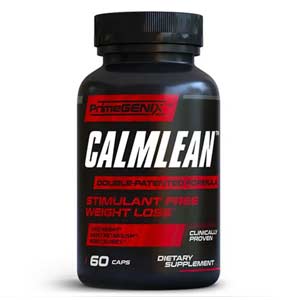
PrimeGENIX CalmLean
Product Type: Dietary Supplement
Primary Use: Weight Management Support
Overall Rating: 4.9/5
Price: $59.00
Key Benefits
- Supports healthy weight management
- Supports metabolic and thermogenic activity
- Supports appetite and hunger management
- Stimulant-free and caffeine-free formula
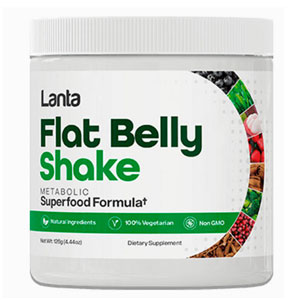
Lanta Flat Belly Shake
Product Type: Dietary Supplement
Primary Use: Weight Management & Metabolic Support
Overall Rating: 4.8/5
Price: $69.00
Key Benefits
- Supports healthy weight management
- Supports metabolism and energy
- Helps manage food cravings
- Supports healthy digestion
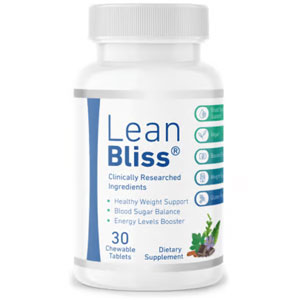
LeanBliss
Product Type: Dietary Supplement
Primary Use: Weight Management & Blood Sugar Support
Overall Rating: 4.8/5
Price: $69.00
Key Benefits
- Supports healthy weight management
- Supports healthy blood sugar levels
- Helps support healthy appetite and craving management
- Stimulant-free formula